Trenching in Ottawa
Water, sewer, hydro and gas trenches cut to grade, with the bedding, fall and backfill the line needs to stay put.

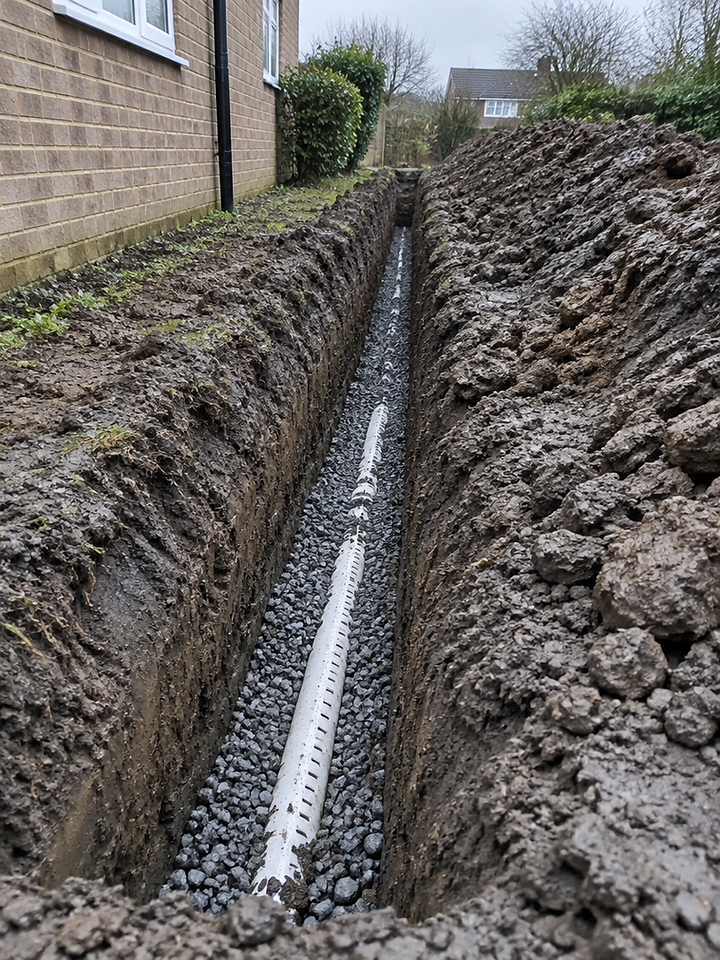
A trench looks like the simplest excavation on a site and is usually the least forgiving. The pipe has to sit on material that will not shift under it, at a fall that keeps water moving in the right direction, and the backfill above it has to compact without loading the pipe or leaving a soft strip that settles under a driveway a year later.
STA 01 / Included
What the work includes
Trenching covers the excavation for water services, sanitary and storm sewer laterals, hydro conduit, gas lines, sump outlets and drainage connections. In general terms, the scope includes cutting the trench along an agreed route, preparing the base, placing bedding material, setting the fall, protecting the pipe during backfill and compacting the material above it.
A trench that crosses a lawn, a driveway or a landscaped bed is planned differently in each case. Lawns can usually be stripped and reinstated. Interlocking pavers can be lifted and relaid. Poured concrete or asphalt has to be cut, and the repair becomes part of the scope. The route is agreed before the saw comes out.
STA 02 / Planning
How a trench is planned
Locates are the first step. Public utilities are marked through Ontario One Call, and machine digging stays clear of the marks. Where a service crosses another, the crossing is checked and the clearances confirmed before the trench is cut through it.
Fall is the second consideration. A sewer lateral or a drainage line works on gravity, so the invert elevation at each end sets the depth along the whole run. The trench is cut from the outlet back or from the building out, depending on which end controls the fall, and the grade is checked as it goes.
Safety of the excavation itself matters on deeper runs. A trench can be benched or sloped, or a trench box used where the depth and the soil require it. Clay walls can stand for a while and then fail without much warning, which is why nobody works in an unprotected trench and why the open length is kept as short as the work allows.
STA 03 / Ground
Frost, clay and access notes
Frost depth is a real consideration for shallow services. A water line that sits too close to the surface can freeze, and the required cover is set by the design and the local practice rather than by what is convenient on the day. In winter, frozen ground slows trenching considerably and may rule out some runs altogether.
Clay makes a tidy trench wall and a difficult backfill. Once it is excavated, wet clay does not compact easily, and material that goes back in wet can settle later. Where a trench crosses a driveway or a sidewalk, the backfill and compaction receive more attention, because that is where settlement shows up first.
Access sets the machine size. A trench in an open rear yard can be cut with a standard machine. A run between two houses, past a fence and a downspout, may need a compact excavator working in short sections. The route and the machine are chosen together.
STA 04 / Timing
When to schedule
The practical time for trenching is before the surfaces above it are finished. Cutting a trench through a new driveway or a fresh patio costs more than cutting it before those surfaces exist, so service runs are usually sequenced with the foundation, the grading and the landscaping rather than after them.
On a renovation, the timing depends on what the trench connects to and whether the interior work is waiting on it. Bringing the trench work forward, while the ground is open and access is still easy, is usually the cheaper order.
Related services
- Foundation Excavation in OttawaFootings and foundation walls dug to a marked layout, with working space left around the forms.
- Grading and Site Preparation in OttawaRough and finish grade, swales, building pad preparation and driveway shaping.
- Drainage and Weeping Tile in OttawaWeeping tile around foundations, swales, catch basins and outlets in general terms.
- All services
STA 05 / FAQ
Trench questions
The Ontario One Call request is placed before digging and the marks are reviewed on site. Private services beyond the public locate, such as a line to a shed or a pool, are confirmed separately before the trench is cut.
It depends on the service, the pipe or conduit being installed and the drawings. Depth is set by the design and by the required fall, not by a single standard figure, and it is checked as the trench is cut.
It can, though the surface usually has to be cut and reinstated afterwards. Where a trench crosses a driveway, the route and the repair are agreed before the work starts so the finish can be matched.
It depends on the material and the space available. Some of it can go back as backfill once the pipe or conduit is bedded and inspected. Surplus material is hauled away.
STA 06 / Start a project
Service line to run?
Tell us what the trench connects and where the route runs, and we will confirm the approach.