Excavation in Barrhaven
Newer subdivisions, shared walls and heavy clay, where the route to the back yard decides the plan.
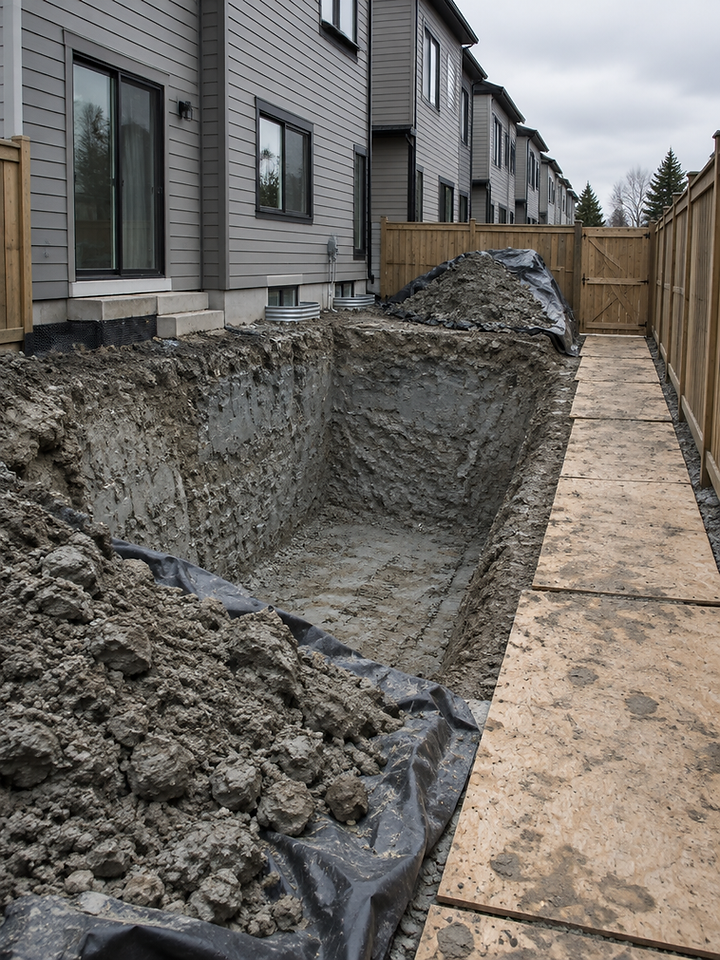
Barrhaven grew quickly, and most of it grew in the last forty years. That makes it a neighbourhood of relatively consistent construction: brick and siding two-storeys, townhome rows, attached garages and rear yards that were finished soon after the houses were. Excavation here is rarely about old foundations and often about access, clay and what the original builder left behind.
STA 01 / Housing
Housing stock
The detached homes generally have a side yard wide enough for a small machine, a driveway beside the garage and a rear yard enclosed by a privacy fence. Townhome rows are tighter, with one access route along the end of the row or through a shared gate, and rear yards that sit directly against a neighbour's.
Additions, basement walkouts, garage extensions and drainage work are the usual reasons for excavation. On the newer streets, homeowners are also digging for pool installations, hot tub pads and shed footings, each of which is a smaller job that still needs the access and the spoil planned.
STA 02 / Access
Rear yard access
On a Barrhaven lot, the rear yard is usually reached through a side gate between the house and the fence. That gap is the controlling dimension. A compact excavator can pass where a full-size machine cannot, but the spoil still has to come back out the same way unless a truck can reach the back.
Protecting the route matters as much as fitting through it. Plywood or mats over a finished lawn, a gravel pad at the gate and a plan for where material is staged keep the access usable and limit the repair at the end. Where the rear yard is fully enclosed, the spoil is usually loaded straight out to avoid stacking it against a fence.
STA 03 / Ground
Clay soils
Barrhaven sits on marine clay in many areas, and it behaves the way clay does: it holds water, it is heavy when wet, and it does not drain quickly. An open hole in clay looks stable and can soften after a day of rain, which is why the excavation is not left open longer than the work requires.
Backfill in clay needs care as well. Material placed back wet will not compact properly, and the settlement shows up later under a patio, a walkway or the edge of a driveway. Placing fill in thin lifts and compacting each one is slower but it is the only way the grade stays where it was set.
STA 04 / Services
Utilities
Barrhaven properties are on municipal water and sewer, with the services running from the street to the front of the house. Locates are cleared before any digging, and rear-yard work still treats the marks seriously because a hydro or gas line can run along a property line or feed a rear-lot meter.
On newer lots, the builder's original grading, sump discharge and drainage swales are part of the design of the subdivision. Changing them without thought can move water onto a neighbour's lot, so the existing drainage is identified before the grade is adjusted.
STA 05 / Season
Frost and timing
The working season follows Ottawa's frost. Digging is practical from the thaw into late fall. In spring, the combination of clay and meltwater makes rear yards soft, and a machine can leave ruts that take a season to settle out of a lawn.
Late summer and early fall are usually the best months for rear-yard work here, when the ground is dry and the surface can be restored before winter.
Nearby areas
The same work is carried out in the communities around here.
STA 06 / FAQ
Barrhaven questions
It depends on the layout. Townhomes usually share walls and have access only along one side, so the machine route and the spoil placement are tighter than on a detached lot. Where the rear yard is enclosed, material is loaded out through the same narrow route it came in by.
Clay holds water and drains slowly, which means an open excavation can soften after rain and a wet spring can make machine access difficult. It also affects how backfill compacts, which is why fill is placed in lifts rather than in one pass.
Not usually. The grade is adjusted around the new work so water still leaves the building, and the surrounding ground is tied back into the existing slope. A full regrade is a separate scope and is only needed where the existing drainage is already failing.
It depends on who owns it and how the access runs. A fence may need a panel removed for the machine to pass, and it is put back at the end. That is agreed with the property owner before the work starts, since the neighbouring side is their property too.
STA 07 / Start a project
A lot in Barrhaven?
Send the address and a description of the rear access, and we will confirm what the work involves.