Excavation in Orleans
Family homes from the 1980s onward, where additions and drainage bring the machines back.

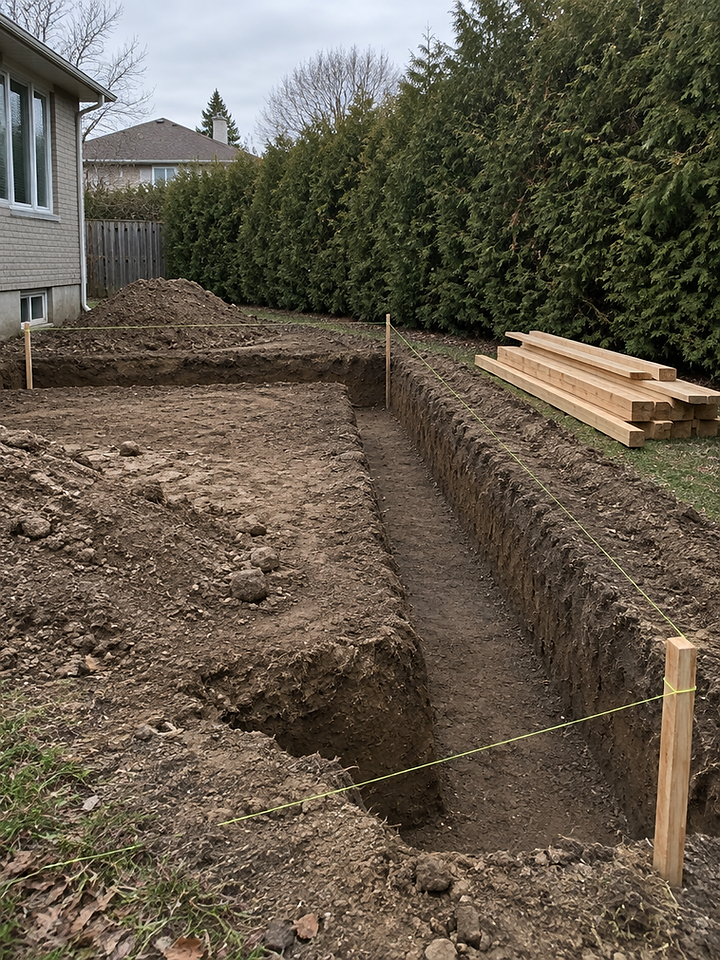
Orleans was built out over roughly two decades, mostly between the 1980s and the 2000s. That gives the area a fairly consistent character: two-storey family homes on lots with a driveway, a side yard and a rear yard that has had time to settle. The excavation work here is largely about the second phase of a property's life rather than the first.
STA 01 / Housing
Housing stock
The houses are typically brick or siding with an attached garage, a poured concrete foundation and a finished basement. Some of the earlier streets have narrower lots and more mature trees; the later phases have wider frontages, larger footprints and landscaping that was installed when the house was new.
Additions are the most common reason to excavate: a rear extension, a larger garage, a sunroom on a proper foundation or a basement walkout. Drainage work follows close behind, since the original systems are now several decades old.
STA 02 / Access
Lot access
Most Orleans lots allow a machine to reach the rear through a side yard, though the width varies street by street. Where a deck, a shed or a fence panel sits in the way, it may need to come out and go back. That is planned in advance rather than decided with a machine already idling in the driveway.
Driveways are usually asphalt or interlock and are the main route for both the machine and the spoil. Where the driveway is the only access, protecting the surface and agreeing the repair is part of the scope. On a lot with a walkway to the rear, the walkway often becomes the route instead.
STA 03 / Ground
Soils
Orleans sits on clay and till, like much of the east end, with the same slow drainage and the same tendency to soften when wet. Excavations are shaped to stand while they are open and are backfilled in compacted lifts so that the ground above does not settle.
Where a lot has been regraded since it was built, there can be a layer of fill over the original soil. Fill placed without compaction is a poor base for a footing or a driveway, and it is one of the things a walkthrough looks for before the excavation is priced.
STA 04 / Services
Utilities and drainage
Orleans properties are on municipal water and sewer. Services come in from the street, and locates are cleared before digging. Sump discharges and downspouts are usually routed to the surface, and where they have been extended over the years, the route may run further than expected.
The area's drainage is designed as a system: swales between lots, catch basins at low points and a storm network that takes the water away. Changing a grade without understanding that system is how water ends up against a foundation two doors down.
STA 05 / Season
Frost and timing
Exterior excavation runs from the spring thaw to the first hard freeze. In Orleans, the spring period is often the most difficult, because clay lots hold meltwater and the ground stays soft well into April and May.
Late summer and early fall are generally the most reliable months, with dry ground, easier access and time to restore a lawn or a driveway before winter.
Nearby areas
The same work is carried out in the communities around here.
STA 06 / FAQ
Orleans questions
It depends on the addition. Most involve stripping the footprint, excavating to the new footing depth, cutting beside the existing foundation and tying the new grade back into the yard. The connection between old and new is where the care goes.
It depends on the property. Lots built through the 1980s and 1990s are now old enough that original weeping tile, sump connections and downspout routing are reaching the end of their life, and a grade that has settled over decades can send water back toward the house.
Often, yes. If the excavation needs the driveway route, the subgrade can be prepared and compacted as part of the grading work, leaving the surface to be installed afterwards. Doing it in one sequence avoids opening the same ground twice.
It depends on the season and the scope. Spring and early summer fill first, and projects that depend on a foundation contractor or a permit have their own deadlines. Booking a season ahead gives room to plan access and timing.
STA 07 / Start a project
A lot in Orleans?
Send the address and what the project involves, and we will confirm access and timing.