Excavation in Cumberland
East-end lots that shift from subdivision to countryside, with the ground changing just as quickly.

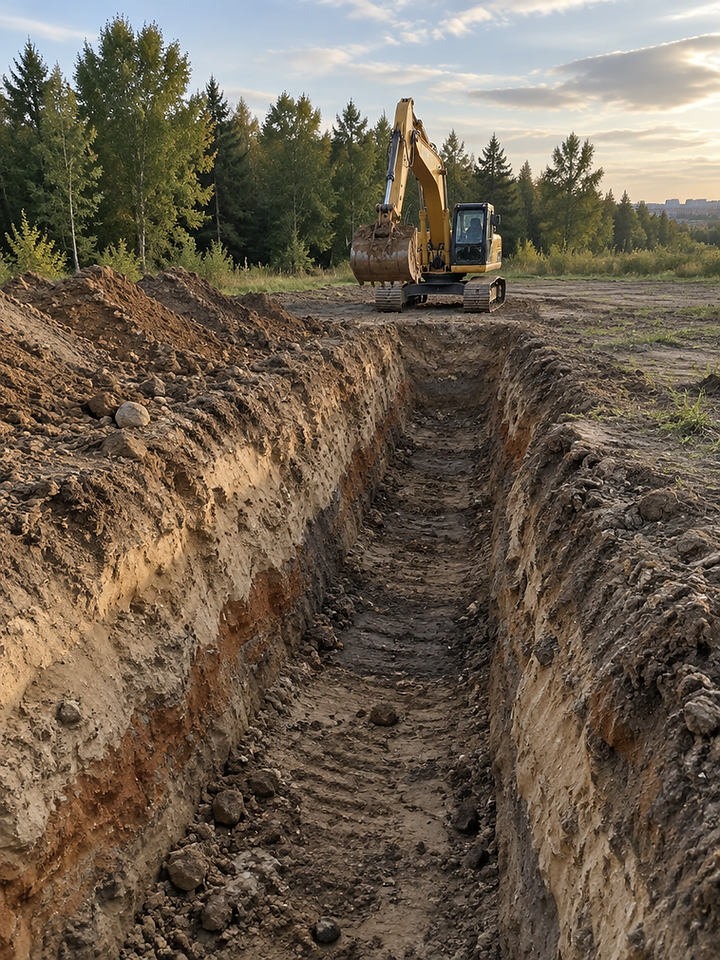
Cumberland runs east from the city's edge into open country. On the way, the lots go from suburban frontage to multi-acre parcels, and the services go from municipal to well and septic. For excavation, that means the approach changes street by street rather than area by area.
STA 01 / Housing
Housing stock
Closer in, the housing is suburban: two-storey homes on fenced lots, townhome rows and the usual pattern of driveways and rear yards. Further out, properties are larger, often with a detached garage, a workshop or a small barn, and the houses are a mix of older rural homes and newer builds.
Excavation spans the same range: additions and drainage on the suburban streets, full foundations and outbuilding pads on the larger parcels, and pool digs where the yard allows.
STA 02 / Access
Room for machinery
On the larger Cumberland lots there is usually space to bring a machine in, stockpile material and turn without crowding the house. That makes the work more efficient and reduces the handling of spoil.
The suburban streets are tighter, with side yards that may or may not take a machine. Where access is restricted, the spoil is loaded out through the same route, and ground protection is used to keep the lawn and driveway usable.
STA 03 / Ground
Mixed soil
The ground across Cumberland varies from clay to sand and till, sometimes within a single property. Sand drains faster than clay but does not stand as well in an open excavation, while clay stands and then softens. Each calls for a different approach to the walls of the hole.
On larger parcels, there are often low or wet corners that were never built on. Those areas are worth identifying early, since they influence where a pad can go and where spoil should not be placed.
STA 04 / Services
Utilities and septic
The suburban parts of Cumberland are on municipal water and sewer, with services from the street. The rural stretches rely on wells and septic systems, and both are located before any digging.
Drainage on the rural lots is handled by ditches, swales and the natural fall of the land rather than a storm sewer. A grade that pushes water toward a road ditch is doing its job; a grade that pushes it onto a neighbour's field is not.
STA 05 / Season
Frost and timing
The season matches the rest of the region, from the thaw to late fall. On the rural parcels, wet spring ground and soft lanes can delay access even when the weather is mild.
Larger projects benefit from an early start in the season, since the area to be opened, worked and restored is greater than on a subdivision lot.
Nearby areas
The same work is carried out in the communities around here.
STA 06 / FAQ
Cumberland questions
It depends where the property sits. The area takes in older settlement lots, newer subdivisions and rural stretches, and the ground ranges from clay to sand and till over short distances. That variation is why a walkthrough matters more than a general description.
Often they do, because there is room to stockpile spoil and to turn a machine. The trade off is longer travel within the site and more area to restore at the end, so the plan still matters.
Not without permission, and it is avoided where possible. Access is usually arranged from the property itself, even if that means a longer route or a smaller machine. A neighbouring lot is their property, and any use of it would need to be agreed with the owner.
It depends on the services. Rural properties may be on wells and septic, with longer driveways and drainage that relies on ditches rather than a storm network. Those conditions are confirmed before the excavation is scoped.
STA 07 / Start a project
A lot in Cumberland?
Send the address and the scope, and we will work out the access and the sequence from there.