Questions, answered plainly
What comes up most often before a site visit, grouped by the part of the work it belongs to.

STA 01 / Planning and access
Planning and access
Drawings, a survey, a site plan or a sketch of what is planned all help. If none of those exist yet, the lot address and a clear description of the work are enough to begin the conversation about access and timing.
By walking the property. Gate widths, side yard clearance, overhead wires, fence lines, driveway construction and the condition of the lawn all determine what machine can be used and how material leaves the site.
Yes. Public utilities are located through Ontario One Call before any excavation, and machine digging stays clear of the marks. Private lines beyond the public locate are confirmed separately before work starts.
Only with the owner permission, and it is avoided where possible. Access is normally arranged from the property being worked on, even where that means a smaller machine or a longer route.
STA 02 / Costs and scheduling
Costs and scheduling
It depends on the project. The volume of material, the depth, the access, the soil conditions, the haul distance and the season all change the work involved. Pricing is prepared per project once the scope is clear.
It depends on the season and the scope. Spring and late fall fill first. Getting in touch once the drawings are close to ready leaves the most room to plan access and timing.
Weather is the usual reason. Frozen ground, a wet spring or a heavy rain period can stop work or limit access. Waiting on permits, drawings or another trade on site also affects the date.
STA 03 / Soils and seasons
Soils and seasons
In general terms, the region has clay, glacial till and, in parts of it, shallow bedrock. Each behaves differently when excavated, and what is actually under a specific lot is confirmed by a geotechnical report, test pits or the excavation itself.
It depends on the work and the frost. Some exterior digging is limited or not practical once the ground is frozen. Planning, locates and interior work can continue through the winter.
The thaw leaves clay soft and heavy. Machine access can damage a lawn, a driveway or a neighbouring lot, and spoil is harder to handle. Waiting for drier ground is often the faster route.
STA 04 / Basements and foundations
Basements and foundations
It depends on the design. Depth is set by the drawings, the footing elevation and the basement height, and it is checked against a benchmark as the dig progresses.
That work requires temporary support and underpinning, which is a separate specialty arranged with an engineer and a contractor qualified for it. Excavation beside an existing foundation for an addition is a different scope.
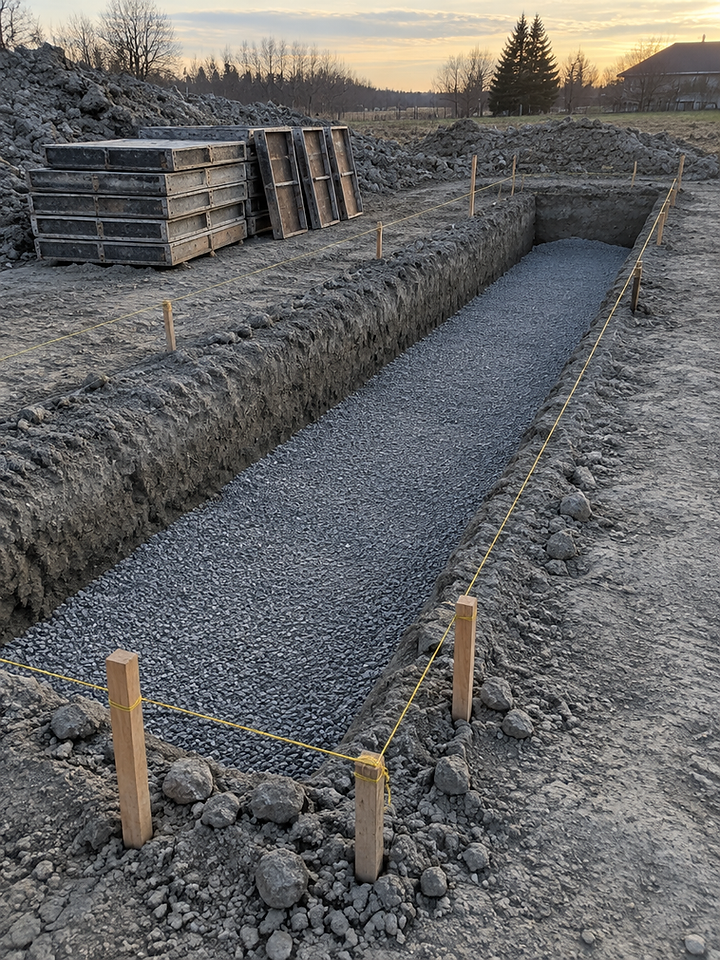
It depends on the drawings and on what the foundation needs for formwork, drainage and inspection. The cut is wider than the wall footprint so the forms can be built and stripped.
It depends on the extent. Fill that cannot support a footing is removed and replaced with compacted material, or the design is adjusted with the engineer. It is raised as soon as it is found, before concrete.
STA 05 / Trenching and drainage
Trenching and drainage
It depends on the service and the design. Depth is set by the required fall and the cover needed for the pipe or conduit, and it is checked as the trench is cut.
It depends on the site. The tile usually connects to a sump, a storm connection or an outlet at grade, and that outlet has to send water somewhere it can leave the lot without affecting a neighbour.
It can. The surface is usually cut and reinstated afterwards, so the route and the repair are agreed before work starts and the finish can be matched.
STA 06 / Pools and demolition
Pools and demolition
No. The excavation prepares the hole to the pool drawings, including the base and the wall shaping. The shell, plumbing and equipment are installed by the pool contractor.
Small structures such as sheds, garages, decks and fences, along with slabs, pads and old foundations. Larger buildings and anything complicated are assessed case by case before any commitment.
It depends on what comes out. Material is sorted as it is removed, and regulated items such as asbestos or fuel tanks require specialist handling and are outside this scope.
STA 07 / Start a project
Still a question left?
Send it with the lot details and we will answer it in the reply, along with anything the site itself raises.