Land Clearing in Ottawa
Brush, small trees and stumps taken out so the lot is ready for the cut that follows.

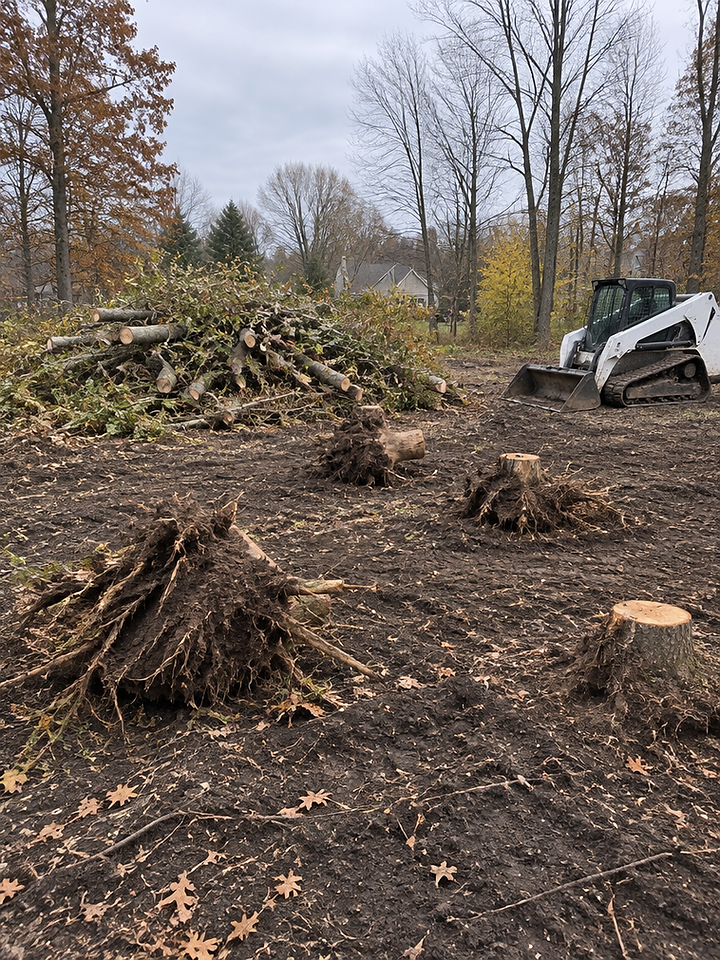
Clearing is the first pass over an overgrown lot, and it is not the same as forestry work. On a residential or small commercial site it means taking out the brush, the small trees and the stumps that sit where the excavation, the driveway or the services need to go, and leaving the ground in a condition where the next stage can actually start.
STA 01 / Included
What the work includes
The usual scope covers cutting and removing brush, saplings and small trees, grubbing out the stumps and root balls, and pulling the material into a workable pile. Where the layout allows, the organic layer is stripped and separated from the mineral soil beneath it so that topsoil can be reused rather than lost.
Clearing often includes the removal of old fence lines, a derelict shed, landscape timbers and accumulated debris that has been sitting on the lot. Each of those changes what has to be hauled away, so they are identified during the walkthrough rather than discovered halfway through.
The finish of a clearing job is deliberate: the lot left open enough to stake a layout, with stumps gone and the surface rough graded so a machine can travel and the excavation can be set out accurately.
STA 02 / Planning
How clearing is planned
The first question is what stays. Trees that are healthy, well placed and outside the work area are marked for protection, with a zone around the trunk where machinery does not travel and material is not stockpiled. Root systems extend well beyond the canopy, and compaction over that area does damage that shows up years later.
The second question is where the material goes. Brush and small wood take up far more space than their weight suggests, so the plan accounts for chipping, hauling or a combination of the two. On a lot with a long drive and a wide gate, that is straightforward. On a narrow infill lot, the volume dictates the number of loads and the order of work.
Access is checked before the first tree comes down. A machine has to reach the far end of the property without damaging a neighbouring fence, a utility pedestal or a mature tree, and it has to be able to turn. Where the only route in is narrow, the work is done in stages from the front of the lot backward.
STA 03 / Ground
Soils, frost and the season
The soil under the growth matters less during clearing than during the excavation that follows, but the season still sets the pace. Frozen ground makes stump removal slow and increases the risk of tearing up more surface than necessary. Very wet ground turns a clearing job into a mud job, and the ruts left behind have to be repaired before grading.
In Ottawa, clearing is usually most efficient in late summer and early fall, when the ground is dry, the growth has stopped and the material is easier to handle. Spring clearing works too, though soft clay can limit where a machine can travel without mats or a stone pad.
Clearing on a lot with a septic system, a well head or buried services needs those located first. Stump grinding over a septic bed is not a mistake worth making.
STA 04 / Timing
When to schedule
Clearing belongs at the very start of a project, before survey stakes go in and well before excavation. A lot that is cleared early gives the surveyor and the designer a clean surface to work from, and it gives the excavation a place to put spoil without fighting brush.
Where a project is waiting on permits, clearing can sometimes be done in advance of the dig, but the limits on what may be removed before approval should be confirmed first. Clearing is difficult to reverse.
Related services
- Basement Excavation in OttawaFull and partial basement digs for new homes and additions, with spoil placed where the lot allows.
- Grading and Site Preparation in OttawaRough and finish grade, swales, building pad preparation and driveway shaping.
- Demolition and Haul-Away in OttawaSmall structure takedown, slab breaking and haul-away of surplus material.
- All services
STA 05 / FAQ
Clearing questions
Stump removal is usually part of the scope when the ground is being prepared for excavation or grading. Leaving stumps in place would mean working around decaying wood and root holes later, which is not a stable base for anything built above it.
Yes, where the layout allows it. Trees worth keeping are identified before work starts, along with a protection zone around the trunk and roots. Keeping a tree and then compacting the ground over its root plate is not really keeping it.
It depends on the volume and the condition of the material. Clean brush and wood can be chipped or removed, and the rest is hauled away. Where burning is considered, the local rules and the season determine whether it is allowed.
It depends on the density of growth, the size of the trees, the stump work and the access. A lightly overgrown lot is a short job. A lot full of mature brush and stumps takes longer and produces more material to remove.
STA 06 / Start a project
An overgrown lot?
Tell us what is growing there and what the lot needs to become, and we will confirm what clearing involves.