Excavation in Stittsville
A village core, new subdivisions and rural edges, each with a different amount of room to work.

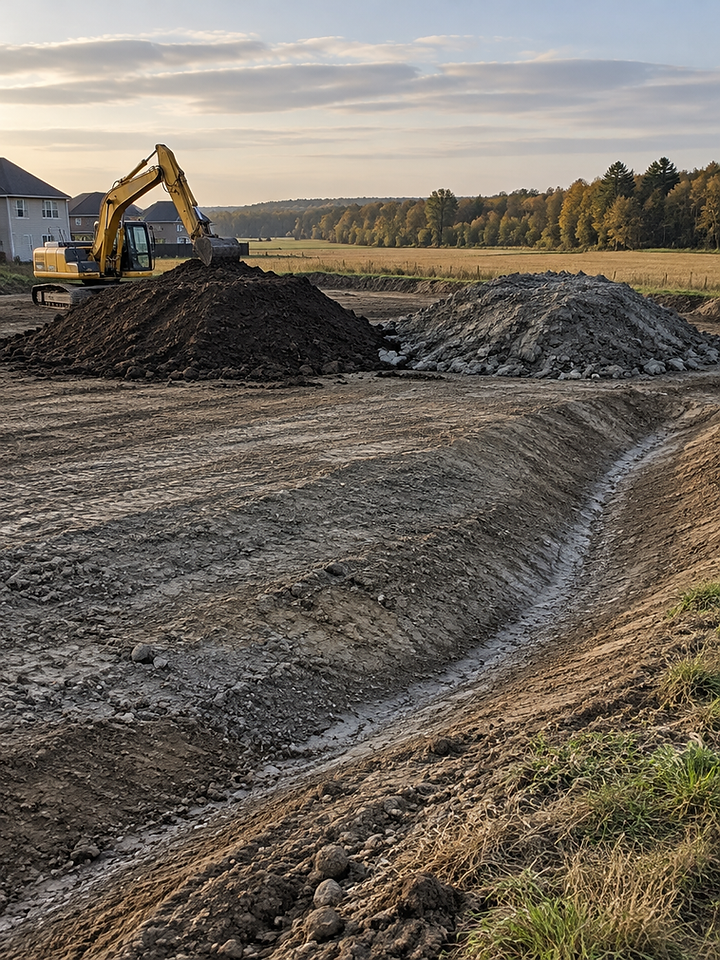
Stittsville has three distinct conditions in one community. The old village core has small lots and older housing. The subdivisions that grew around it have newer homes and wider streets. Beyond them, the rural edges have larger properties, longer driveways and, in places, wells and septic systems.
STA 01 / Housing
Housing stock
In the village core, homes are often older and sit close to the street, with mature trees and narrow side yards. The newer subdivisions bring two-storey homes on lots with attached garages, fenced rear yards and landscaping installed at construction.
On the rural edges, properties are larger and often have outbuildings: a detached garage, a workshop or a shed. Excavation there can include pads for those structures as well as work on the house itself.
STA 02 / Access
Room to work
Larger lots are easier in one way and harder in another. There is room to stockpile spoil and to turn a machine, which reduces handling. But the distances are longer, so material moves further and the haul route across a large property becomes part of the time on site.
On the village core lots, access is tighter and the route often runs over established landscaping. Where a driveway or a garden bed is the only way in, protection and a plan for restoring the surface are agreed beforehand.
STA 03 / Ground
Soils
Much of Stittsville is clay and till, with areas of sandier material toward the rural edges. Clay behaves as it does elsewhere in Ottawa: it holds water, softens when saturated and needs to be worked in the right conditions.
On larger properties, a change in soil across the site is common. One corner may be clay, another may be sand or fill from an earlier building. That is worth knowing before a foundation pad or a driveway base is designed.
STA 04 / Services
Utilities and septic
The subdivisions are on municipal water and sewer, with services from the street. Properties on the rural edges often have a well and a septic system, and both are located before excavation begins.
A septic bed is not a place to park a machine, and a well head is not a place to stockpile clay. Where the work is anywhere near either, the locations are confirmed on site rather than assumed from a sketch.
STA 05 / Season
Frost and timing
The frost season here matches the rest of the city, with exterior work from the thaw to late fall. On the rural edges, longer driveways can be the first thing to become impassable in a wet spring, so access is checked against the weather as the date approaches.
For new builds, the excavation is tied to the builder's schedule and the foundation trade. For additions, the timing often depends on when the drawings and permits are ready.
Nearby areas
The same work is carried out in the communities around here.
STA 06 / FAQ
Stittsville questions
The village core has older, smaller lots with established landscaping and sometimes shared driveways. Access is tighter than in the new subdivisions, and the excavation is often an addition or a drainage job rather than a full basement.
It depends on the volume. Larger rear yards allow material to be stockpiled and reused to raise grade or shape a swale, which reduces hauling. On smaller lots most of the spoil leaves the site.
Some do, particularly where larger lots meet the countryside. Septic beds, wells and the lines between them are located before any excavation so the work stays clear of them.
The grade is set to the lot grading plan so water leaves the building and the lot drains as designed. Swales between properties are preserved, and the finished grade is tied into the neighbouring lots rather than set in isolation.
STA 07 / Start a project
A lot in Stittsville?
Send the address and the scope, and we will confirm access, spoil placement and timing.