Excavation in Kanata
From Beaverbrook bungalows to new Kanata Lakes builds, the ground and the access set the method.

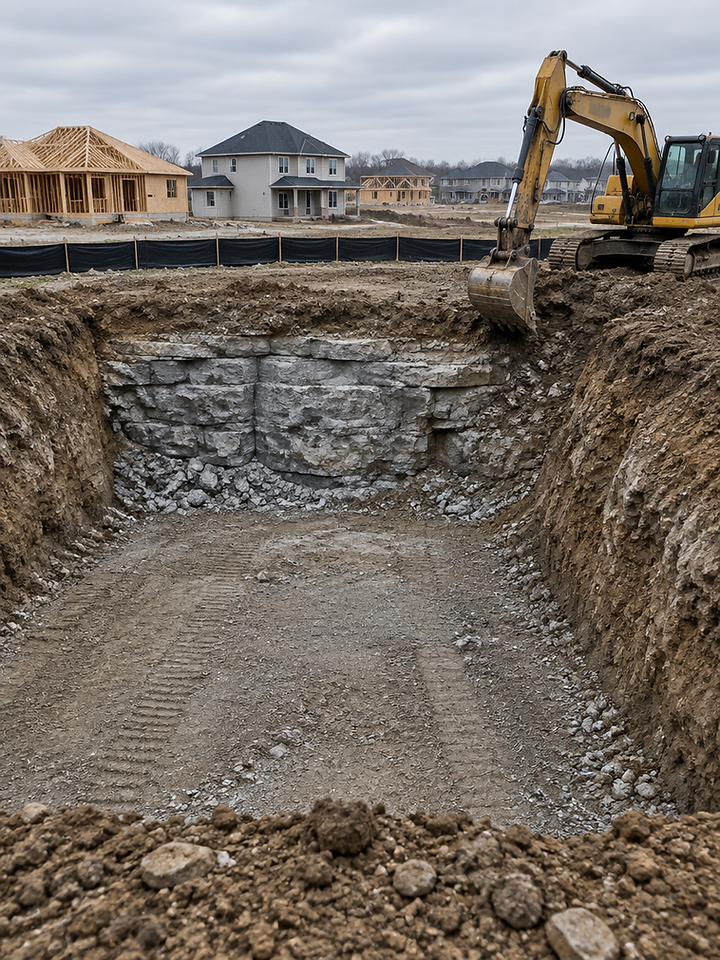
Kanata is not one kind of neighbourhood. It runs from the tree-lined streets of Beaverbrook, built through the late 1970s and 1980s, through the townhouse clusters of Katimavik and the 1990s expansions, out to newer subdivisions where the houses are still going up. Excavation work follows that spread: additions and drainage on established streets, basement digs on older homes, and full foundation work on new lots.
STA 01 / Housing
Housing stock
The older parts of Kanata are dominated by two-storey family homes and townhouses on lots laid out in the 1970s and 1980s. Those properties typically have a finished basement, a driveway at the side and a fence line close to the house. Additions usually mean excavating beside an existing foundation, keeping the new footing at the right depth relative to the old one, and restoring a grade that has had decades to settle.
Kanata Lakes and the newer phases bring larger footprints, deeper basements and, in some cases, walkout designs that step with the slope. New builds there are usually straightforward excavations with room around the hole, though the sequencing with the builder's other trades matters more than the digging itself.
STA 02 / Access
Lot access
On the older streets, access is the constraint that shapes the job. A mature maple over the driveway, a fence running to the property line and a side yard barely wide enough for a wheelbarrow all limit what can get to the back of the house. A compact machine working in stages, with spoil loaded out through the same route, is often the practical answer.
Newer subdivisions offer wider driveways and more open ground, but they bring their own limits: rear lanes, swales that have to be preserved, finished landscaping and, on some lots, no rear access at all. Where the only route is between two houses, the protection of the ground and the neighbour's fence becomes part of the plan.
STA 03 / Ground
Soils and rock
Much of Kanata is clay and glacial till, with the same behaviour that clay shows across the city: it cuts cleanly, holds water and softens after rain. Excavations are shaped to stay stable while they are open, and the open time is kept short.
Rock is the local variation worth knowing about. Pockets of shallow bedrock appear in parts of Kanata, especially toward the north and in some of the lake-adjacent subdivisions. Where rock sits close to the surface, the footing depth, the method of removal and the time involved all change. Raising it before the dig is scheduled is far easier than discovering it at two metres.
STA 04 / Services
Utilities and services
Most Kanata properties are on municipal water and sewer, with services running from the street to the house under the front lawn. Older lots may have services at shallower depths than current standards, and any excavation near the front of the house starts with the locate marks reviewed and the route confirmed.
The rural edges of Kanata, where larger properties meet the surrounding countryside, include wells and septic systems. On those lots the well head, the septic bed and the line between them are located before any dig, because both are expensive to disturb and easy to misjudge from a drawing.
STA 05 / Season
Frost and timing
Kanata follows the Ottawa frost calendar. Exterior excavation is practical from the thaw into late fall, with the spring thaw the least forgiving period on clay. Frozen ground limits digging through the winter, and work that has to happen early in the year is usually booked well ahead.
For additions, the excavation often lines up with the foundation contractor's schedule, so confirming the dig date early keeps the rest of the project on track.
Nearby areas
The same work is carried out in the communities around here.
STA 06 / FAQ
Kanata questions
In places, yes. Shallow rock appears in parts of Kanata, particularly toward the north and around some of the lake subdivisions. Where it is close to the surface, footing depths and the method of removal change, so it is worth raising before the dig is scheduled.
Beaverbrook and the earlier streets have mature trees, narrower driveways and fences along most property lines. Access is usually through the side yard with a compact machine, and spoil is either loaded out through the same route or staged where a truck can reach it without crossing a neighbour's property.
Additions, walkout modifications, garage replacements and drainage work are the usual reasons to excavate. The foundation itself is often sound, so the work focuses on the new footprint, the connection to the existing wall and the grade around it.
It depends on the scope and on the City of Ottawa requirements for the specific property. Work that changes a footprint, a grade or a lot coverage usually requires approval and drawings prepared by others, and those should be in hand before the excavation is scheduled.
STA 07 / Start a project
A lot in Kanata?
Send the address and the work involved, and we will confirm access and timing for that street.